


My first two weeks at SAMA (by Nora)

Updated: Feb 27
Entering the Field: From Observer to Participant
My experience at SAMA has only just begun, yet the first days have already reshaped my understanding of what it means to work in culture. Before arriving in Amsterdam, I had worked in cultural institutions where much of my time was spent behind a desk — planning, coordinating, communicating from within an office. At SAMA, however, that model quickly proved insufficient. Street art cannot be understood from a distance. It demands presence. Within my first week, I found myself walking through Nieuw-West, documenting the condition of artworks in the SAMA collection, observing how weather, time and human interaction leave visible traces on them. I explored street art scattered across Amsterdam, not as a tourist but as a researcher of urban visual language. I attended meetings with community members, visited independent galleries and spoke directly with artists. Office work remains part of my responsibilities, but it is no longer the centre of the experience — it supports what happens outside.
This shift from observation to participation has been crucial. Traditional art forms — such as the paintings of Rembrandt or Van Gogh — are preserved within controlled environments and studied through books and catalogues. Street art operates differently. It exists within society rather than apart from it. It can be touched, altered, challenged. It acts as a mediator between institutions, communities and individuals. If museum art often reflects the vision of a single creator, street art frequently carries collective narratives. It emerges from specific social contexts and responds to them. To understand it, one must move from abstraction & theory into the lived reality of a specific neighbourhood.
Street Art as Social Infrastructure
In the recent years, street art is often reduced to decoration in order to please everybody, but in Nieuw-West it functions as something much deeper: a form of social infrastructure. This neighbourhood is home to 128 nationalities and very diverse social realities. SAMA operates within this context not merely as a cultural organisation, but as a connector. Through participatory projects, it translates community memories, concerns and aspirations into visual form. One example that deeply impressed me is Memories by the Colombian artist Bastardilla. I encountered the mural while inspecting the collection. The project initially had a different concept. It was meant to honour the residents’ collective protests against the renovation of the housing blocks, drawing inspiration from the white banners they had hung from their balconies as a sign of resistance. However, many residents felt that this visual reference revived painful and conflict-laden memories. In response, the concept was thoughtfully reconsidered through dialogue with the community.
The final mural evolved into a vibrant composition portraying a figure patterned with blue birds, gazing at a flame formed by a flock in motion. Rather than recalling division, the imagery conveys warmth, resilience and hope. It transforms a history of struggle into a vision of possibility, offering a sense of optimism for the future.

Co-Creation in Practice: Who Really Decides?
One of the most important lessons I have learned so far is that street art, at its best, does not follow a top-down model. It is grounded in co-creation and shared ownership. During one of my first days, I attended a neighbourhood meeting in Dichtersbuurt, facilitated by municipality in order to gather the residents to discuss future ideas and their wishes for the co-development of their neighbourhood. Ideas were exchanged openly, and participants wrote suggestions on large sheets of paper. The atmosphere was informal but structured, inclusive & purposeful. What struck me most was the sense of co-ownership: projects were not being presented to the community — they were being shaped by it. This experience motivated me to join the linguistic café hosted in the same space by priest Bram, where Dutch native speakers help newcomers practice the language. There, I spoke with people from Iraq, Iran and Ireland. Communication unfolded collaboratively; no one judged grammatical mistakes. Meaning was built together. In many ways, this reflected the ethos of street art itself — participation over perfection, dialogue over authority.
I observed a similar openness within the artistic community. While walking along Marnixstraat, I entered The London Police x Suye gallery. Inside, artists were not only exhibiting but actively creating, conversing and sharing space with visitors. The founder of The London Police, Chaz, welcomed me into the conversation. The boundaries between artist, curator and audience dissolved. Art was not presented as a finished product, but as an ongoing process. Through this encounter, I was introduced to another artist, Chinny Bond, who offered advice about exhibitions in Amsterdam. Acting on his suggestion, I visited Ambassade Art Gallery to see works by Alberto De Flavis, an Italian tattoo artist and painter. These interactions revealed a cultural ecosystem built on informal networks, mutual support and horizontal exchange rather than rigid hierarchies.

I also had the opportunity to visit Nicholas Groente & Fruit, Brian’s neighbourhood shop where fresh produce and wine are sold alongside art books and works by local artists. The space occasionally hosts small exhibitions, blurring the line between commerce and culture. This encounter revealed another dimension of the street art ecosystem: many artists sustain themselves through hybrid practices, combining creative production with other forms of livelihood. Seeing artworks displayed among food and everyday goods illustrated how street art inhabits daily life, integrating itself into ordinary spaces rather than remaining confined to institutional settings.

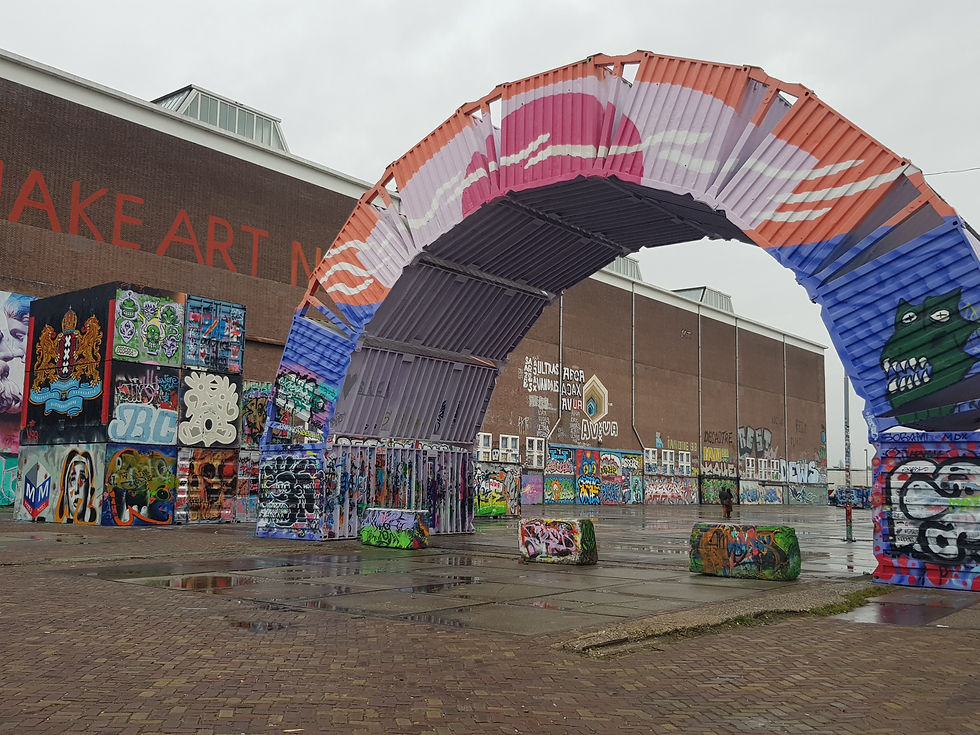
Another significant visit was to NDSM, a former shipyard in Amsterdam Noord along the banks of the IJ. Once an industrial site, it has been transformed into a vast public space hosting markets, concerts and exhibitions. What is most striking, however, is how the area is enveloped in murals, graffiti and large-scale installations. At NDSM, creativity operates with a remarkable degree of freedom. The site embodies how urban regeneration can create room for artistic experimentation while remaining accessible to a broad public.
Recently, during a workshop in SAMA’s community garden I was able to put into practice what I learned from the STAR 2.0 toolkit. This event was led by youth workers of Vooruit organisation, some of whom, like Fabian, I met at the European Placemaking week in Reggio Emilia. Under the supervision of the local street artist and youth worker - Cika - children were given a street art tour, where they learned in a non-formal way diverse styles and techniques for making art in and for public space. Later, they together designed stencils and sprayed their own artworks, encouraged by the youth workers. This is where I see the strength of SAMA: art as a medium for inclusion, dialogue and empowerment.


