


An Afternoon at Checkpoint Charlie: Finding Community Through Amsterdam's Street Art Scene
- Isabelle Zamundu

- Jun 25
- 3 min read
Updated: Jun 28
One of my first opportunities to explore more of Amsterdam came when Anna invited me to join her as a plus one to Chinny Bond's birthday party. However, this was more than any mere social gathering; contemporary artists who laid the foundations for the Amsterdam’ street art culture were going to be in attendance. As an intern at a museum dedicated to Street Art, it felt like an opportunity to better understand the people who form the beating heart of this community.
The celebration was held at Checkpoint Charlie, drawing me into a part of Amsterdam I had never explored before. Walking into the venue, I found myself surrounded by unfamiliar faces. Artists, designers, curators, and creatives slowly filtered through the doors, greeting one another with the ease of old friends. At that moment, Anna was the only person I knew: and she was running late. It wasn’t truly an inconvenience, but I was nervous: how was I to navigate a room of such greatness alone, with no context and no familiarity?

Not long after I arrived, Anna appeared, loudly sang Chinny a happy birthday, sat me down among a circle of friends, and disappeared almost immediately in search of drinks. Suddenly, I was plugged into the action. I watched conversations unfold from the corner of a leather couch, but found myself sitting next to artists who were also nursing drinks and snacking.
What followed was one of the most welcoming experiences I've had since arriving in the Netherlands.
As a foreigner trying to understand Amsterdam's street art culture, I expected to spend the evening quietly observing. Instead, I was met with curiosity, generosity, and a genuine willingness to share stories. Conversation after conversation revealed how interconnected this community truly is. Despite coming from different backgrounds, disciplines, and countries, the people in the room seemed united by a shared commitment to supporting one another's work.

I met Elena Dovè, whose realist oil paintings of the feminine figure are rendered almost entirely in shades of blue. We spoke about her artistic practice and how it reflects her own response to the technical conventions she learned during her time in Russia. Her work felt both deeply personal and quietly rebellious in the context of her educational background. Some of her pieces are actually being exhibited at a space where Chinny works in Amsterdam's city center, which I hope to see before they come down.

I also met Tony van Amsterdam, an artist who had also spent time in Colorado and was familiar with Indigenous artists there. We even have a close friend in common: JayCee Beyale, a talented Navajo muralist based in Denver. Our conversation quickly expanded beyond Amsterdam, proving how artistic networks often stretch across continents. Through shared experiences, artists maintain connections that transcend geography.

Another memorable conversation was with Sophie Teppema, a watercolor artist who also crafts ornate gold frames. Having traveled extensively around the world, she carried with her a wealth of stories and influences gathered from different places and cultures. Speaking with her reminded me that artists often serve as collectors of experiences, translating their journeys into creative work.
The room was also filled with graphic designers and multidisciplinary creatives whose practices extended far beyond any single medium. Everywhere I turned, there was another story, another collaboration, another connection waiting to be uncovered.

At the center of it all was the birthday boy himself: Chinny Bond. As both a renowned street artist and curator, he had brought together an extraordinary group of people. Furthermore, he was so welcoming to me, somebody who he'd just met! He offered me slices of gluten-free birthday cake as we finally got the opportunity to connect with one another. Looking around the room and eating my slices, it became clear that the gathering was about much more than a birthday. It was a reflection of the community he has helped cultivate over the years.
What struck me most throughout the evening was the realization that art often acts as a map of relationships. Artists tell stories about their own lives, but those stories are also shaped by friendships, travels, collaborations, and shared experiences. Every conversation revealed another thread connecting people across cities, countries, and artistic disciplines.
The Dutch street art scene may appear local at first glance, but its roots and influences stretch around the globe. Artists support one another despite distance, differing opportunities, and varying paths through the creative world. Through their work and their communities, they demonstrate something easy to forget: we are far more interconnected than we realize.
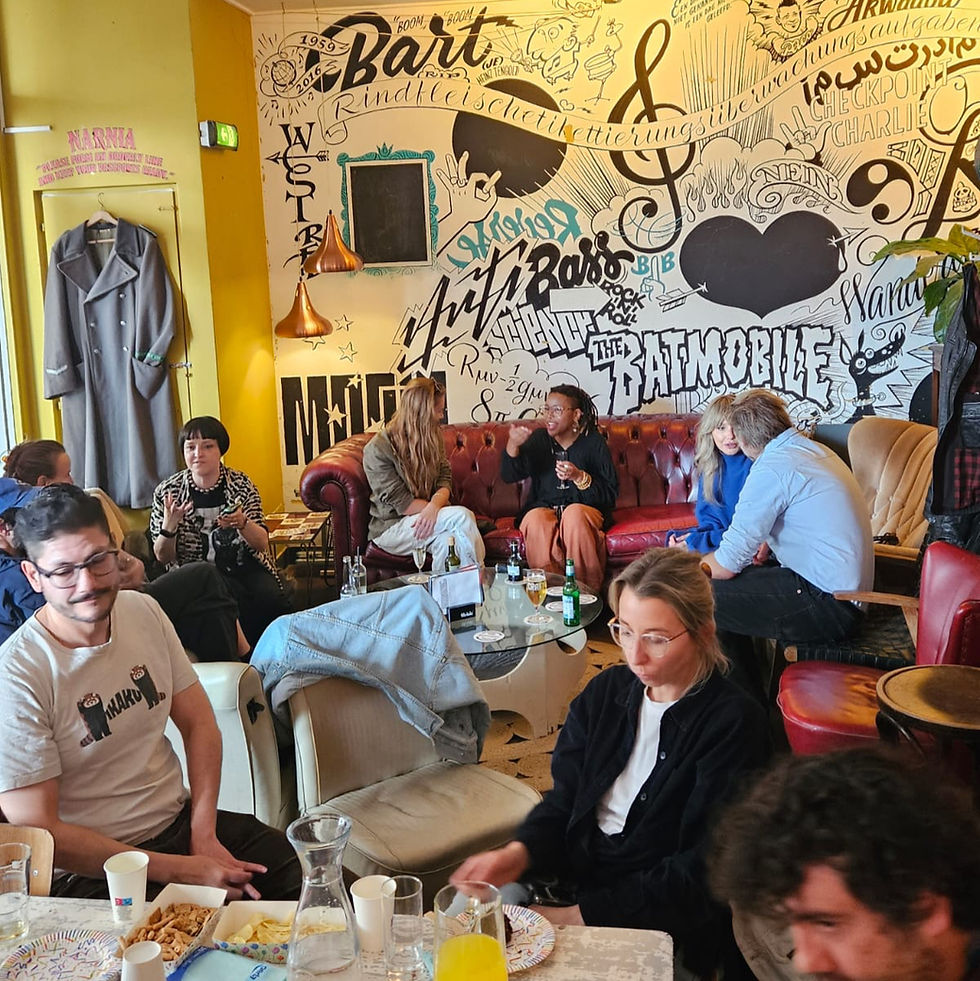
As I left Checkpoint Charlie that evening, I felt I had gained something more valuable than an introduction to Amsterdam's street art culture. I had witnessed a community in action; one built not only on art, but on generosity, curiosity, and connection.


