


What Can Street Art Learn from Citizen Science? (And Vice Versa?)

Yesterday, SAMA had the pleasure of participating in EXTREME CITIZENS SCIENCE HUB Amsterdam — a day dedicated to exploring how knowledge can be created together with citizens, communities, researchers and institutions.
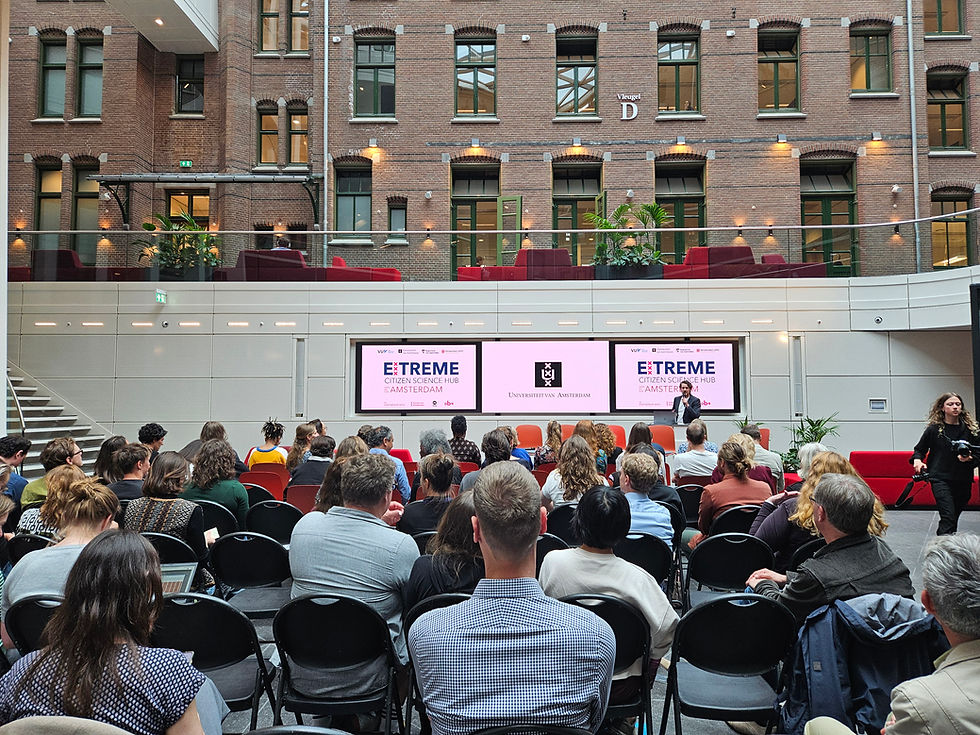
We attended as a team: together with our intern Isabelle Zamundu and volunteer Furkan Demir, we joined conversations, explored projects and shared SAMA’s growing work at the intersection of culture, participation and public knowledge.

Walking through the event, one thing became increasingly clear: citizen science is no longer only about collecting data. It is becoming a way of recognising different forms of expertise and creating new relationships between institutions and communities. Across presentations, conversations and project stands, we encountered initiatives working on neighbourhood knowledge, environmental monitoring, media literacy, wellbeing, collective mapping and lived experience as expertise.
What connected them was not the topic itself, but a shared shift in perspective: moving from research about people to research with people.

For us at SAMA, this felt deeply familiar. And perhaps our stand reflected that. While many participants shared reports, methods and research outputs, we arrived with something more tangible: fragrant herbs and edible flowers harvested from our own Buurttuin van Verhalen (Garden of Stories), developed with support from Fonds voor Cultuurparticipatie and Oranje Fonds.

It turned out to be the only stand that visitors could not only look at, but smell, touch and taste. That felt symbolic. Because SAMA’s journey over the past years has not been linear. We started by painting murals and documenting street art. We grew a collection. But over time, our work evolved from preserving artworks to asking what cultural collections can actually do.
Can they become tools for dialogue?
Can they help us understand neighbourhood change?
Can they support collective learning?
Can they improve the places we live in?

Today, we see our collection not as an endpoint, but as infrastructure for participation, research and collective action. At Extreeme Citizen Science Hub, we shared examples across different scales. From hyper-local initiatives such as Buurttuin van Verhalen and the community newspaper Buurtkrant — supporting neighbourhood connection, storytelling and local agency. To national collaborations including Digital Street Art Depot (Cultuurloket DigitALL), exploring digital preservation of street art, and the Participatory Evaluation of Artworks in Public Space developed together with the Cultural Heritage Agency of the Netherlands (RCE–FARO). To international projects such as Bloomberg Connects and the Erasmus+ Toolkit for Youth Workers, where we explore how public culture can support learning, accessibility and exchange across borders. We also presented STRAATWIJS (NWO), which helps us explore how academic research and community expertise do not simply coexist — but strengthen each other and increase social impact.
Across all of these projects runs one common question: What happens when communities are not only audiences, but active contributors to cultural knowledge?
Participating in Amsterdam Citizen Science reinforced something we increasingly believe:
communities do not start producing knowledge once institutions invite them. Communities already produce knowledge. The challenge for cultural organisations is not creating participation, but learning how to recognise existing knowledge, create space for it and work with it responsibly.
A big thank you to everyone who stopped by our stand, exchanged ideas, challenged assumptions and shared inspiration — and especially to Isabelle and Furkan for bringing curiosity, energy and thoughtful conversations throughout the day. This experience felt less like discovering a new direction and more like finding language for work we have already been doing.
Next stop: Europe.
You can continue this conversation with SAMA at ESEE2026 in Ghent, where we will bring questions of participation, collective knowledge, culture and social transformation into a broader European dialogue. Themes such as citizen participation, governance and reimagining places strongly resonate with the questions we are exploring in Amsterdam. If you are attending ESEE2026, come find us. Join SAMA there — and let’s explore together what becomes possible when communities are recognised not only as audiences, but as researchers, curators and co-authors of change.


