


We Started a Museum as a Joke.

We Started a Museum as a Joke. Then We Discovered We Had a Collection.
On community wealth, subjective collections, organic strategy and who gets to decide what a museum is
The Joke
In the late 1970s, Jean-Michel Basquiat and Al Diaz began writing SAMO on walls around Manhattan. Short for Same Old Shit, SAMO was a fictional brand and a satirical intervention into a society and cultural establishment they found absurd. Their messages questioned authority, conformity and consumerism. They were making a point, not planning an artistic movement.
A few decades later, in Amsterdam Nieuw-West, we started something with a strangely similar spirit. We called it the Street Art Museum Amsterdam. SAMA.

It was, at least partly, a joke. We wanted to challenge the established art world and its assumptions about what counted as art, who could create it and who had the authority to decide. Street art was emerging from the overlooked, sometimes literally piss-soaked corners of the urban jungle, made by people who often had neither formal artistic education nor institutional recognition. We believed ordinary people and self-taught artists could make just as much difference as formally educated professionals and established cultural institutions.
And if we couldn't prove it? Well, at least we could create critical mass. We had absolutely no idea that we were starting a museum.
She Had a Demand. I Had a Solution.
My partner in crime was Dianne, a local mother of five. We met at a meeting of active residents. She wanted more activities in the neighbourhood, particularly outdoors. I was already supporting street artists and believed that art could bring people together.
She had a demand. I had a solution. So we began. Murals. Workshops. Pop-ups. Activities in public space. When we needed paint, people contributed money, sometimes just five euros. When we needed an airbrush machine or a lift, someone helped arrange it. When we needed volunteers, neighbours turned up.
We didn't have a wealthy patron. We had a neighbourhood.
Within two years, we had 35 artworks. By 2015, more than 50. Nobody had given us a collection policy. Nobody had commissioned a museum strategy. Nobody had told us we were building a cultural institution. We were simply doing things, and the neighbourhood was doing them with us.
The Accusation: No Strategy
For almost ten years, I was criticised for not having a strategy. My answer was always the same: organic. I wanted to see where things would go. This was not particularly convincing to people who believed a serious cultural organisation should know what it intended to become, how it would get there and what measurable outcomes it would deliver. But how could I write a strategy for something whose possibilities I had not yet discovered?
Looking back, I recognise an important distinction: not knowing your destination is not the same as having no direction. We knew what mattered. We believed in the creative capacity of ordinary people, the importance of public space and the possibility of making culture without waiting for institutional permission. What we didn't know was what these convictions might produce. Management theory has a term for this: emergent strategy, associated with Henry Mintzberg. Rather than implementing a predetermined plan, an organisation develops patterns of action through experience, experimentation and learning.
I didn't know the term then. I called it organic. And I still do.
Apparently, I Had a Collection
Around 2015, I was invited to speak at a heritage academy about the phenomenon we had created in Amsterdam Nieuw-West. Afterwards, a student asked whether she could do an internship at SAMA. Six months later, she came to a conclusion: "You have a collection." I had to look up what that meant.
Until then, my understanding of a museum had been conventional. A museum was a building. It had objects, exhibitions, professionals and visitors. We had streets, walls, artists and neighbours. But apparently, we also had a collection.
Suddenly, the joke in our name wasn't quite so funny anymore. We had called ourselves a museum to question the authority of museums. Now someone was telling us that we might actually be one.
Your Artists. Your Friends. Your Collection.
In 2019–2020, two master's students from the same heritage academy investigated whether SAMA could qualify for registration in the Dutch Museumregister. Their conclusion was that we did not meet the requirements.
Our practice was not sufficiently object-driven. We lacked a formal collection policy.
And there was another criticism that had followed me for years: the collection was subjective. My choices. My friends. My artists. A real museum, I was told, was curated. This argument fascinated me. Three of my favourite collectors were Peggy Guggenheim, Ernst Beyeler and Helene Kröller-Müller. Their collections were profoundly shaped by personal judgement, artistic preferences, relationships and individual convictions. Today, those collections are celebrated as expressions of extraordinary curatorial vision.
So when does personal taste become expertise? When does a network become cultural influence? And when does a subjective selection become a legitimate collection?
I am not suggesting SAMA did not need a collection policy. It did. Nor am I arguing that my choices were beyond criticism. Curation requires accountability. Personal relationships can create blind spots. Informal selection can exclude people, even unintentionally. But the idea that established museums are somehow free from subjectivity deserves scrutiny. Collections do not fall from the sky. Someone chooses. Someone values. Someone decides what is worth preserving.
The important question is not whether those decisions are subjective. It is whose subjectivity is recognised as legitimate cultural authority.
We Had Wealth Too
There was another difference between SAMA and the famous private collections I admired. Guggenheim, Beyeler and Kröller-Müller had access to extraordinary private financial resources. SAMA did not. Or so I thought.
SAMA had wealth too. It was simply distributed across a community rather than concentrated in one person's bank account: money, skills, time, equipment, relationships and trust. Residents contributed five euros for paint. They lent equipment, volunteered their weekends, opened doors, made introductions and helped artists realise their work.
One of our murals, SAFETY by ALANIZ, even carries the names of the people who contributed to its creation. Their names are written on the wall. In a conventional museum, a wealthy donor might have their name on a plaque beside an artwork. In our museum, the contributors became part of the artwork itself. And the residents considered those murals theirs. Not necessarily through legal ownership, but through investment, participation, attachment and belonging. This complicates the accusation that SAMA was simply my personal collection. Yes, I selected artists. Yes, my relationships helped shape the collection. But I did not create it alone. The choices may have been mine, but the museum was never mine alone.
Traditional provenance research asks where an artwork came from, who owned it and how it changed hands. But what if we also asked who made its existence possible? Who paid for the paint? Who lent the lift? Who offered a wall? Who convinced a neighbour that this strange artistic experiment was worth supporting? These contributions are not incidental. They are part of the artwork's history, social meaning and cultural value. SAMA was not a museum without capital. It was a museum whose capital was held by the community.
Then the Museums Closed
In 2020, COVID-19 arrived. Museums across the Netherlands closed their doors.
Our museum remained accessible. The very characteristic that had complicated our institutional recognition — a collection dispersed across public space, without a conventional museum building — suddenly became our greatest advantage. People could still walk through the neighbourhood, discover murals and experience culture without entering an institution. The pandemic did not prove that the Museumregister's professional requirements were wrong. But it exposed the limits of equating a museum's public value with its building, objects or institutional infrastructure. Sometimes accessibility is not something a museum provides through its doors. Sometimes accessibility is what happens when there are no doors.
Theory Arrived After Practice
Around this period, SAMA received a grant from the Mondriaan Fund, enabling us to appoint a collection manager, Leonie Wingen. Leonie helped professionalise our approach to the collection and introduced me to the Council of Europe's Faro Convention on the Value of Cultural Heritage for Society.
Another intellectual door opened. Faro, with its emphasis on the social value of heritage and the participation of communities in identifying and interpreting that value, helped me understand something I had been doing intuitively for years. We had never begun with objects. The artworks emerged from relationships, needs, conversations and shared activities. The collection was a consequence of those processes. This was not a sudden conversion to participatory heritage. It was recognition. But recognition also brought responsibility.
If communities helped create cultural value, why should I alone decide what was valuable?
If residents considered the artworks theirs, how should their perspectives shape documentation, interpretation and preservation?
And if a mural disappeared, what exactly had the museum lost?
The painted surface?
The artistic expression?
The relationship between the artist and the neighbourhood?
Or the memories and experiences that had accumulated around it?
These questions became central to SAMA's work. They informed our interest in participatory valuation, citizen science and the development of the Digital Street Art Depot. We began developing methodologies to document not only artworks, but their contexts, histories and social meanings. What had once been intuition could now be articulated, examined, tested and shared. Faro did not teach me that communities mattered. Dianne and the residents of Nieuw-West had taught me that long before. Theory did not replace practice. It gave us the tools to question, understand and make that practice accountable.
The Museum I Could Have Claimed as My Artwork
In 1917, Marcel Duchamp submitted an ordinary urinal as Fountain, raising a question that would haunt the art world for the next century: who gets to decide what is art? The provocation was not about the beauty of the object. It was about selection, context, authorship and authority.
Duchamp brought a urinal into the exhibition. Almost a century later, we brought the museum to the corners people used as one.
We took ordinary walls, invited street artists to transform them and called the result a museum. Then something unexpected happened. The artworks accumulated. Residents contributed resources and labour. Artists brought their imagination. People began to consider the murals theirs. What started as an artistic and social experiment became something larger.
And in 2019, I faced a choice: was SAMA an institution, or was it Anna's art project?
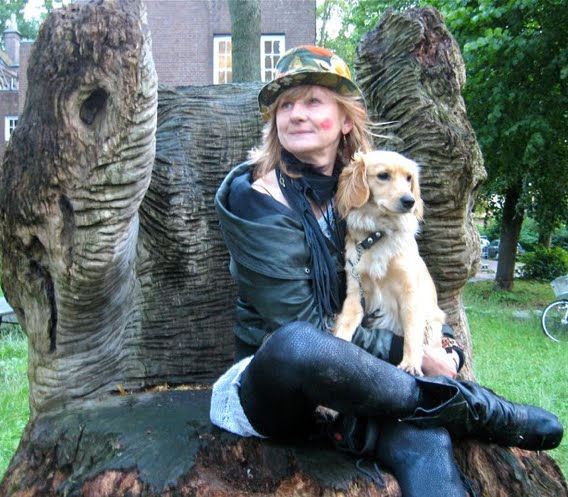
I could have chosen the latter. I had initiated the collaborations, selected the artists and helped transform an ordinary neighbourhood into an open-air collection. I could have framed the whole undertaking as a long-duration conceptual artwork in the lineage of Duchamp's institutional provocations. In that reading, the criticism that SAMA was subjective would have been almost irrelevant. Of course it was subjective. It would have been my artwork. My choices, my vision, my authorship.
But I chose the institution.
Not because I wanted a building, a title or the authority that comes with running a museum. I chose it because what we had created was already bigger than me. Dianne had brought the needs of her neighbourhood. Residents had contributed their money, equipment, weekends and trust. Artists had contributed their creativity and labour. How could I claim all of that as my personal artistic achievement? The initiative may have been mine, but the creation was collective.
Choosing an institution meant accepting a different responsibility. An artwork can remain an expression of its author. An institution, at least in principle, must be able to develop beyond its founder. It needs continuity, accountability, governance and room for other people to question and change what has been created.
For years, I had defended SAMA's lack of a predetermined strategy with one word: organic. Yet faced with the choice between personal authorship and institutional identity, I made a deliberate decision. Perhaps this was my first genuinely conscious institutional strategy: to build something that, eventually, should no longer depend on me.
But that choice created a contradiction. I had spent years questioning the authority of traditional museums. Now I was building an institution that would exercise authority of its own.
Who would select the artists?
Who would decide what belonged in the collection, and which artworks deserved documentation, preservation or restoration?
Whose voices would be heard?
Duchamp questioned the mechanisms through which an object becomes recognised as art. SAMA was beginning to question the mechanisms through which artistic and social practices become recognised as heritage.
If Duchamp challenged the authority to define art, SAMA challenges the authority to define heritage.
But there is a difference. Duchamp's gesture celebrated the power of artistic selection. SAMA's evolution kept running into its limits. Choosing an institution did not automatically make SAMA democratic. The founder's vision remained influential. Informal networks could include people, but also exclude them.
Professionalisation therefore could not simply mean replacing organic relationships with policies and procedures. It had to mean making decisions transparent, opening them to scrutiny and creating real opportunities for others to take part.
Perhaps the most radical consequence of choosing an institution is accepting that, one day, it must be able to question its own creator.
Who Gets to Decide?
Looking back, I see a curious sequence. We challenged the authority of the traditional art world. Then we discovered we had a collection. Then we were told it did not meet professional expectations. Then a pandemic revealed the public value of our unconventional museum. And participatory heritage gave us a framework to question not only the authority of established museums, but our own.
It would be easy to turn this into a heroic story about outsiders proving the establishment wrong. That would be too simple. The criticism was not always unjustified. We needed documentation, policies, professional expertise and more transparency about how decisions were made.
What I question is the assumption that professionalisation must mean abandoning the qualities that made an organisation culturally significant in the first place.
Must an organic initiative become predictable to be taken seriously?
Must a collection lose its subjectivity to become legitimate?
Can a museum become professional without surrendering its capacity to experiment?
These questions remain central to my work and my studies in cultural leadership. The challenge is no longer simply to gain recognition. It is to build an institution that can hold complexity without closing down the openness that made it possible.
The Joke Is Still on Us
SAMO began as a provocation. Basquiat and Diaz could hardly have anticipated the cultural history that followed. SAMA began with a different provocation, in a different city, under very different circumstances. We did not intend to establish a museum. We wanted activities outdoors, support for street artists and proof that ordinary people could make a difference. If nothing else, we hoped to create critical mass.
Fourteen years later, I am still trying to understand what we created. For years, people asked where SAMA was going. I didn't know. I wanted to find out.
Today, I can describe our development in the language of emergent strategy, participatory heritage, collective patronage, citizen science and community-based museology. But those words arrived long after the first five-euro contributions, the borrowed machines and the neighbours who said yes.
We did not begin with museum theory. We began with people, and those people, without knowing it, helped create a museum. A museum, it turns out, is not defined by the name it claims or the authority it challenges. It is defined by how it gathers value, how it shares authority and whether it stays answerable to the people who made it possible.
Dianne wanted more activities outdoors. She got a museum without doors.
Perhaps the most radical thing about SAMA was never that we called ourselves a museum. It was that we didn't wait for anyone's permission to become one.

---------
Street Art Museum Amsterdam (SAMA) was founded in Amsterdam Nieuw-West in 2012. Its open-air collection emerged through collaborations between street artists, residents and local partners. Today, SAMA explores how community participation, heritage valuation and digital preservation can challenge and expand conventional museum practice.


