


Around the Block with Bijlmer Boogie

On a particularly sunny afternoon, I waited beneath Kraaiennest Station in Amsterdam Zuid-Oost, an area I’d never been to before. Before our mural crawl with Bijlmer Boogie began, I found myself doing what I often do in a new place: looking around. I stood still near a pillar to take in my surroundings. It already felt different from the parts of Amsterdam I had come to know. Most notably, the pace was different: leisurely with this strong undertone of excitement.
Soon, I met Anna and Beter Blijleven to begin our adventure for the day. Peter is one of the graffiti writers for Bijlmer Boogie. When I first arrived, I exclusively expected to learn about street art. Instead, I found myself learning about history, migration, politics, and the ways a community continues to redefine itself.

Before we even sat down to talk, he welcomed me inside and made coffee while Anna crossed the street to Albert Heijn to pick up cheese and cold drinks for the unusually warm day. It was a simple gesture, but one that reflected something I had already begun to notice throughout the trip: hospitality and community often sit at the center of this artistic network. I vividly remember gazing up from the couch at all the art pieces on the wall. The space felt homey. I sat back into the couch and instantly relaxed.
As we waited for the rest of our group to arrive, I learned more about Beter. Beter began writing graffiti in the early 2000s, but our conversation extended far beyond graffiti itself. We spoke about citizenship, public space, and his belief that the government should ultimately work for the people, not the other way around. That philosophy shapes the way he approaches walls: not simply as surfaces to paint, but as public spaces that belong to everyone.
While contemplating this idea, our conversation naturally turned toward street art history.
Peter recommended Amsterdam Graffiti: The Battle of Waterloo, which documents the evolution of Amsterdam's graffiti scene. During the 1980s, artists from New York introduced many Dutch writers to train painting alongside broader elements of hip-hop culture. At the time, Amsterdam's scene had largely grown from punk influences. Those exchanges helped shape what Dutch graffiti would become, creating a dialogue between local culture and international movements that continues today.

After Anna, Tom, and Valerie arrived, we cracked open some drinks and talked about mutual connections in Amsterdam’s artist network. Although I was unfamiliar with the people, a theme that emerged was the agency of street artists. When they are asked to work on projects for institutions, how much of the artist’s process remains their own? What parts of that process are selectively shown? Before we had even left the building, I already felt as though I had been given a tour of Amsterdam’s street art scene. Eventually, we set off on a walking tour of the neighborhood's murals.
One of our first stops was right across the street. The artists explained that they had spent the previous evening creating a mural together: painting late into the night, sharing drinks, laughing, and enjoying each other's company. The mural had been created in response to a recent loss within the community. What struck me wasn't only the finished piece, but the process itself. The act of making it together became part of the healing.
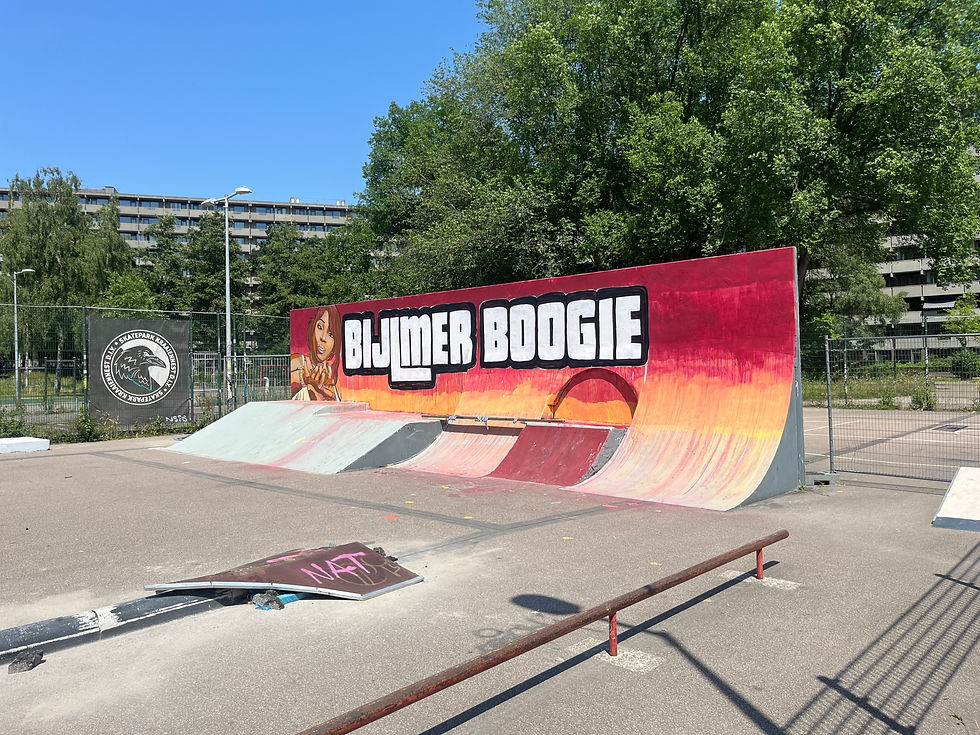
As we continued through the neighborhood, the conversation expanded beyond the walls themselves. To better understand the art, I realized, you also have to understand Zuid-Oost.
Bijlmer was envisioned as a modern district, its high-rise buildings representing ambitious ideas about urban living and social progress. Over time, however, the neighborhood became home to many immigrant communities, particularly people with ties to Suriname following the country's independence in 1975. Today, Zuid-Oost is one of the most culturally diverse areas in the Netherlands, and that diversity is visible not only in its residents but also throughout its public art.
I felt grateful for the opportunity to immerse myself in that diversity. Our new friends had introduced me to telo, a delicious Surinamese dish. They also opened up about their experiences growing up in the area and seeing what it’s becoming: on the one hand, the safety of the area has changed in a way that is more positive. On the other hand, the identity of the neighborhood is also changing in unfamiliar ways. How do you navigate this change as not only a resident familiar with the streets, but also as a street artist?
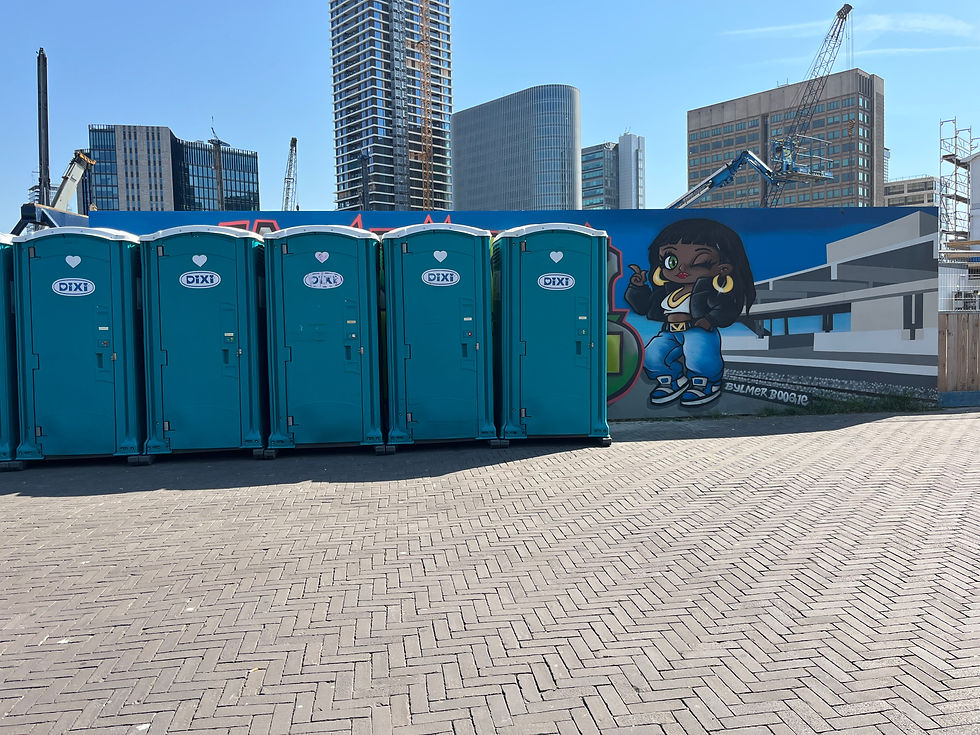
Like many cities around the world, Amsterdam is grappling with redevelopment and rising housing costs. As investment flows into Zuid-Oost, conversations about gentrification have become increasingly urgent. The murals didn't exist outside of these changes: they often become part of the conversation surrounding them.
We had spent the day walking through areas where the effects of gentrification were clearly visible in the changing population. While the art was telling a story about the neighborhood, so were the groups that surrounded us as we took our tour. With my past experience as a tour guide, it was a wonderful reminder that the people who experience the art play a critical role in how the artwork is understood and the story itself.
As an intern with Street Art Museum Amsterdam, I found myself thinking not only about the artwork but also about the role institutions usually play within street art culture. SAMA began by documenting works that existed only temporarily, which is what makes it so unique. That mission remains important because street art is inherently temporary due to its dependence on environment. Buildings are renovated. Murals fade. Neighborhoods change.
Yet documenting an art form defined by its impermanence also raises larger questions.
Who gets recognized when public art enters institutional spaces? Who benefits when street art becomes celebrated? And how can institutions ensure they are amplifying artists rather than speaking over them?
Anna's work explores many of these questions. Rather than measuring success solely through visitor numbers or economic impact, she is developing ways to understand how street art affects artists, residents, policymakers, and researchers alike. It is an effort to bridge lived experience with academic research, acknowledging that the impact of public art cannot always be captured through statistics alone. This is something she consistently accomplishes through a personal system she calls the...
The Measurement of Impact!
It provides quantifiable evidence that organizations can use to continuously obtain resources for the communities they're in while also not reducing the work to statistics for the sake of academic use. It's a form of citizen science that is actively being explored in SAMA's everyday practice.
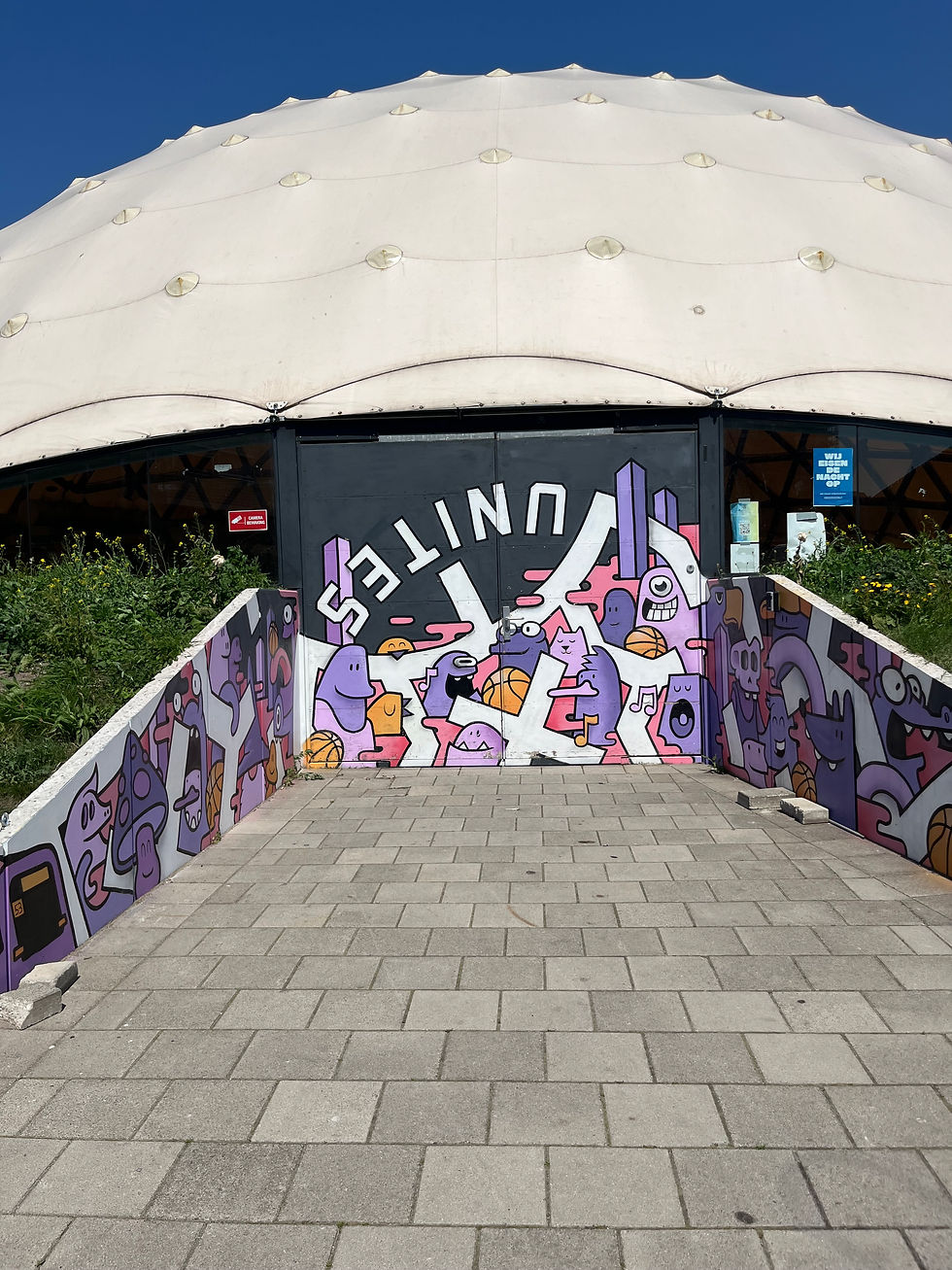
This experience also made me think about visibility. Artists sometimes contribute significantly to institutional projects while remaining largely invisible within the final presentation. Recognition, funding, and authorship do not always flow back to the people who create the work. As street art becomes increasingly accepted by museums, governments, and cultural organizations, these questions become even more important.
By the end of my brief time in Zuid-Oost, I had been introduced to a neighborhood whose walls carry stories of migration, resilience, friendship, grief, creativity, and change. The murals are certainly beautiful, but their real significance lies in the communities that create and care for them.
As a museum dedicated to documenting street art, preserving these works means preserving something larger than the art itself. It means documenting the people, histories, and conversations that give the walls their meaning.


